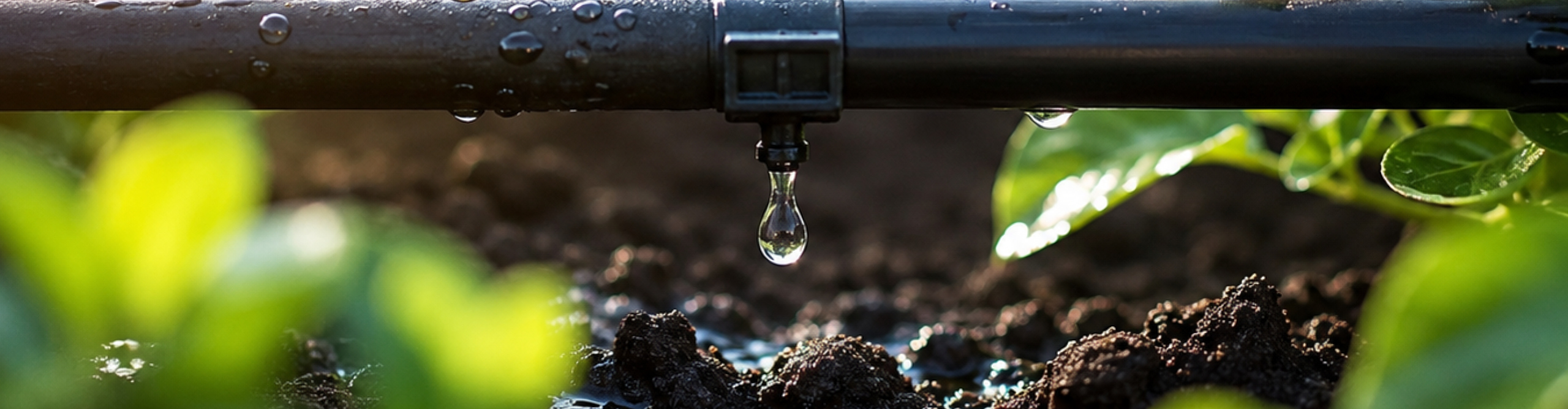
Drip irrigation systems are the backbone of modern agriculture, enabling the controlled, precise, and uniform delivery of water and nutrients directly to the crop’s root zone. However, the operational efficiency of these systems is constantly threatened by emitter clogging.
In greenhouses and open fields, the maintenance and repair costs associated with damaged drip irrigation systems can be extremely high, highlighting the critical economic importance of routine prevention and cleaning protocols (Dehghanisanij H, 2025).
1. The Challenge of Drip Emitter Clogging at the End of the Irrigation Season
The main causes of clogging in drip irrigation systems are classified into three categories:
- Physical: silt, sand, and particles.
- Biological: algae, bacteria, and the formation of slimy biofilm.
- Chemical: the accumulation of mineral deposits and limescale (Pei, 2014).
Of these, mineral precipitation—particularly limescale—is one of the most difficult challenges encountered in the field. Water from calcareous aquifers contains high concentrations of calcium ions (Ca²⁺), magnesium ions (Mg²⁺), and bicarbonates (HCO₃⁻).
The pH of this water is generally around 8.0, promoting the oxidation of micronutrients and making them unavailable to the plant. At the same time, it accelerates the precipitation of calcium carbonate (CaCO₃) as a solid calcareous deposit within the narrow labyrinth of the drip emitter (CHAVAN et al., 2016).
Although irrigation water containing fertilizers is generally acidic, microscopic deposits accumulate throughout the season and become increasingly significant toward its end. As irrigation frequency decreases and temperatures rise inside pipes exposed to solar radiation, residual water in the drip laterals evaporates, creating hard, dry, consolidated limescale that firmly establishes blockages inside the emitters.
Therefore, carrying out a thorough chemical treatment to dissolve these deposits toward the end of the irrigation season—while the system is still wet—is essential for maintaining the system’s integrity and ensuring its proper operation during the following season (et al., 2025).
2. Sulfodrip
The conventional treatment of calcareous deposits is based on injecting strong acids to achieve a pH of approximately 3–5, causing the carbonates to dissolve again (Dehghanisanij H, 2025). Although concentrated inorganic acids such as sulfuric acid (H₂SO₄) or hydrochloric acid (HCl) provide high chemical strength, they pose serious safety hazards to operators and cause accelerated corrosion of metal fittings and filtration systems.
Our new product, Sulfodrip, manufactured by Deshen Hatzafon, delivers powerful performance with a significantly improved level of safety. Sulfodrip is produced through a controlled synthesis reaction between free urea and concentrated sulfuric acid.
The key benefits of Sulfodrip:
- Improved operator safety:
In this stable complex, the urea molecule acts as a weak base that binds the protons of the sulfuric acid. This bond dramatically reduces the activity of free hydrogen ions in the concentrated solution, helping to prevent immediate chemical burns in the event of accidental skin contact and reducing the product’s hazard level compared with free sulfuric acid. - Full acidifying power after dilution:
Once the product is injected into the irrigation system and diluted with water, the chemical bond breaks down fully and immediately. The sulfuric acid is then released and provides full acidifying power equivalent to that of free acid, neutralizing bicarbonates and dissolving solid calcium carbonate into soluble salts that can be flushed out of the system. - Added nutritional value:
Each liter of Sulfodrip contains 15% amide nitrogen and 40% sulfur. In perennial crops, including orchards and vineyards, these nutrients are efficiently absorbed by the roots at the end of the season and help build essential energy reserves for the following spring growth cycle. - Improved availability of micronutrients:
Sulfodrip improves the availability of micronutrients such as iron, zinc, and manganese in the soil by locally acidifying the root-zone environment.
3. Detailed Practical Protocol for Cleaning the Drip Irrigation System at the End of the Season
Performing periodic cleaning toward the end of the irrigation season requires a systematic and precise approach to ensure that deposits are dissolved without causing mechanical damage to the system.
The following is the recommended practical protocol:
Stage A: Preliminary Physical Flushing
Flushing the system with clean water before injecting the acidic product is essential for the success of the treatment. This process removes silt, sludge, and suspended physical particles, preventing them from becoming compacted inside the emitter labyrinth when the pH changes and the deposits begin to break down.
- Flushing procedure:
Flush all system components, including mainlines, manifolds, and laterals—in that order—to ensure sufficient flow velocity and flushing pressure to push the debris out of the system. During the final stage, open the ends of the laterals sequentially, six laterals at a time, to achieve high flushing pressure and remove suspended particles from the lines. - Verify that all fertigation components are resistant to strong acids, including the fertilizer tank, the fittings connecting the tank to the pump, the pump itself, and the connection to the irrigation pipe. Tanks and pipes made of polyethylene or PVC are not sensitive to acid.
Stage B: Sulfodrip Injection
Operate the irrigation system and wait until it reaches full, stable operating pressure. Activate the fertigation pump and inject the product for 20–40 minutes. The product may be diluted with water in the fertilizer tank according to the flow rate of the injection pump.
Recommended injection rates:
- Routine or preventive treatment:
1 liter of Sulfodrip per 1 m³ of irrigation water. - Treatment of existing blockages:
1.5–2 liters of Sulfodrip per 1 m³ of irrigation water.
Acidity monitoring:
During injection, measure the pH of the water emitted from the dripline at the end of the most distant lateral. The recommended target pH should fall below 3.0 to ensure rapid dissolution of limescale and mineral deposits.
If the treatment is carried out while sensitive plants are present—particularly young plants with shallow root systems—do not expose the roots to water at pH 3.0 for more than 30 consecutive minutes, in order to prevent chemical damage to the active root system.
Stage C: Static Contact Period
Immediately after completing the acid injection, shut down the irrigation system completely. Leave the concentrated acidic water standing inside the pipes for at least four hours. In cases of severe clogging, it is recommended to leave the solution in the system overnight.
This prolonged contact period is essential for allowing the acid to thoroughly break down and dissolve the hard calcium carbonate crystals within the emitter labyrinth.
Stage D: Final Flushing and Filter Cleaning
At the end of the contact period, restart the irrigation system using clean water only, without adding any product.
- Irrigate with clean water for at least 10 minutes. For pipes or system components that are sensitive to corrosion, it is recommended to extend the flushing period to as long as one hour, ensuring the complete removal of residual acid and dissolved salts from the pipes.
- Reopen the ends of the laterals and manifolds sequentially to discharge the dissolved limescale residues.
- Immediately afterward, dismantle the system filters and clean them thoroughly by hand to remove suspended particles and debris trapped during the process.
4. Safety
Although Sulfodrip is safer to handle than concentrated free acids, it is still classified as an acidic and hazardous substance. Strict compliance with all field safety and handling instructions is therefore required.
- Mandatory personal protective equipment (PPE):
During handling, mixing, and injection, operators must wear sealed chemical-splash safety goggles, a full-face shield, chemical-resistant protective gloves made of neoprene or PVC, closed footwear, and suitable protective clothing. - The product is intended for agricultural use only. Avoid mixing it with other substances.
End the irrigation season with peace of mind—clean your drip emitters with Sulfodrip and keep your irrigation infrastructure clean, efficient, and ready for the next season.
For further information, professional consultation, and precise dosage adjustment based on your water quality, contact the agronomy team at Sheffa, part of Deshen Hatzafon, today.
References
al, C. M. e., 2025. Reducing fouling and emitter clogging in saline water drip irrigation systems by choosing suitable nitrogen fertilizer. Case Studies in Chemical and Environmental Engineering.
CHAVAN, V. K., DESHMUKH, S. & NAGDEVE, M., 2016. Mechanism of emitter clogging: A review. Wastewater Management for Irrigation: Principles and Practices. FL, USA: CRC Press: Boca Raton.
Dehghanisanij H, M. S. E. S. R. T., 2025. Reducing the clogging of emitters in drip irrigation systems using acid washing and ultrasonic technology. PubMed Central.
Pei, Y. L. Y. L. Y. et al., 2014. Eight emitters clogging characteristics and its suitability under on-site reclaimed water drip irrigation. Springer, pp. 141–157.